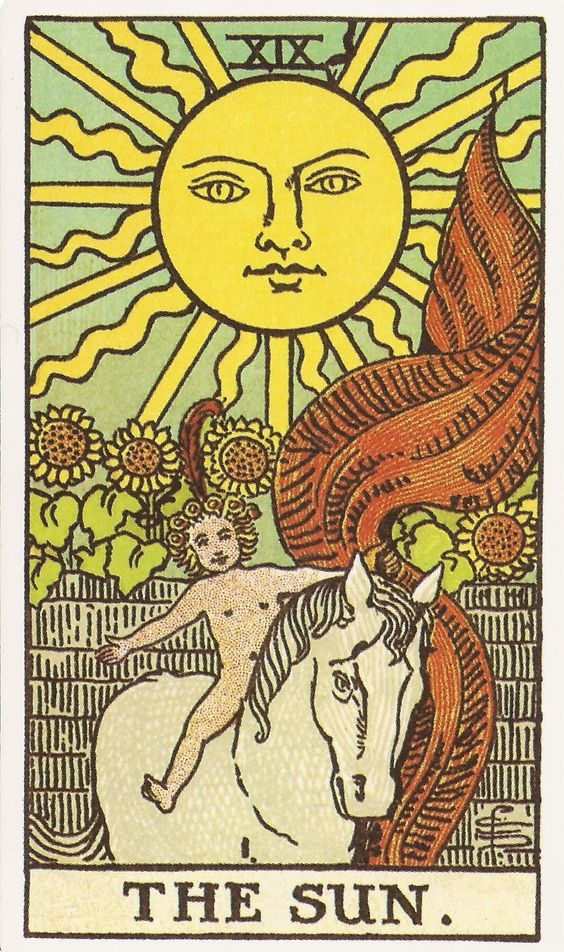
Home Tarot Deck The Sun

The Sun

Major Arcana · XIX

Introduction to Tarot Cards

The Sun (XIX), in its upright expression, belongs to the Major Arcana and stands as a bright, confident archetype of success, luminous clarity, and revitalizing optimism. It invites open authenticity and warm self‑expression, celebrating visible progress and life‑affirming momentum.

Within the arcana, The Sun symbolizes illumination and life‑force: a radiant, generative presence that nourishes growth, aligns intent with action, and turns potential into palpable outcomes.

Key themes include success, clear understanding, sustained vitality, upbeat optimism, genuine joy, and steady growth.

The Sun

Tarot Card Symbolism Analysis

• The Sun: The sun with a human face is the source of energy. Its 21 rays symbolize the completion of the Major Arcana journey, representing truth, warmth, and vitality that dispel all darkness.

• Child + White Horse: The naked child embodies the "authentic self"—unpretentious and fearless. The white horse signifies purity and harmony, while the unsaddled, reinless state reflects "inner peace and unity with the world."

• Sunflowers + Red Flags: Sunflowers represent the pursuit of light, and red flags symbolize the outward expression of passion and vitality, suggesting "actively embracing the world and sharing joy."

• Walls: They serve as both "protection (shielding from negativity)" and a metaphor for "freedom after breaking through constraints."

Use The Sun's energy for your personalized insight

Book Your Personalized Reading
The Sun icon

Upright Meaning

Overall State

Abundant energy and inner joy permeate every aspect of life, as you \"grow toward the sun.\" Past confusion and troubles have been dispelled.

Love

Clear and sincere connections—sweet romance, happy marriage, or meeting a "sunshine-filled" partner if single. Engagement or marriage may even be on the horizon.

Career/Academia

Achievement of goals and recognition for your abilities (successful projects, smooth exams). You’ll unlock creativity in this positive mindset.

Social/Finances

Strong social bonds and rising financial luck, possibly with unexpected gains. A gentle reminder: "Stay authentic"—your light will naturally attract like-minded souls.

The Sun icon

Reversed Meaning

Overall State

Your once-abundant vitality gives way to exhaustion—you may feel emotionally drained from overexertion (e.g., forcing a "sunny" persona). Alternatively, you might appear fulfilled on the surface but feel empty inside, lacking genuine joy.

Love

Hidden truths linger in the connection (e.g., pretending to be happy), or unresolved conflicts emerge as passion fades. Singles may encounter someone who "seems sunny but hides behind a facade."

Career/Academia

You may achieve your goals but feel unfulfilled as expected. Or, minor setbacks arise from carelessness or overconfidence, preventing you from fully showcasing your abilities.

Reminder

There’s no need to force a "perfect facade"—allow yourself to rest. Stay vigilant against self-deception: this temporary darkness is a nudge to "turn inward and reconnect with your authentic motivation".

History & Symbolism

1. The Archetype of "The Sun" in Early Tarot (15th–18th Centuries)

"The Sun" is a fixed Major Arcana card, with its earliest known appearance in the Visconti-Sforza Tarot (one of the oldest surviving tarot decks) from 15th-century Italy.

  • Early versions of The Sun featured simple imagery: typically a "sun with a human face against a minimal background," symbolizing "the source of life"—without later elements like children or white horses.
  • In 17th–18th century European tarot decks (e.g., the Marseille Tarot, Jacques Viéville Tarot), The Sun began incorporating "naked children": some depicted two children playing, others a child riding a horse and holding a red flag. This became one of the design prototypes for The Sun in the Rider-Waite Tarot.

2. The Birth of the Modern Rider-Waite Sun Card (1909)

The iconic version we know today—featuring a child, white horse, and sunflowers—was designed for the Rider-Waite Tarot through a collaboration between esoteric scholar Arthur Edward Waite and artist Pamela Colman Smith:

  • Waite drew inspiration from 17th-century Belgian/Spanish tarot motifs of "a child riding a horse with a flag," while integrating Hermetic Order of the Golden Dawn symbolism (e.g., the sun’s 21 rays correspond to the 21 Major Arcana, and sunflowers represent the Four Elements).
  • He simplified "two children" to a single naked child, avoiding confusion with "The Lovers" (linked to Gemini in Western tarot) and emphasizing themes of authenticity and freedom through the image of an unbound child. The white horse references Norse runic associations between the sun and "unstoppable life force."

3. Cultural Roots of the Symbols

The core imagery of The Sun (sun, child, light) blends cross-cultural influences:

  • Ancient Greek Apollo (god of the sun, light, and art) and Egyptian Ra (sun god associated with the solar barge and rebirth);
  • Medieval Christian concepts of "divine light as truth and life";
  • Renaissance Neoplatonism’s idea of "emanation of light" (the One creating all things through a flow of light).